Friday, June 28, 2013

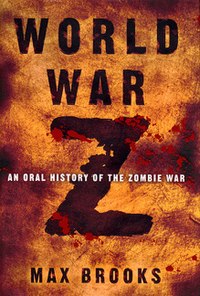
Book Review: World War Z


Zombie books are usually campy, dumb affair; not taken seriously in literary circles, and for good reason. They are horrible books that cover cheesiness with page after page of gore and swearing, simply appeasing our id's desire for violence and foulness. Well, the book "World War Z", written by Max Brooks, decided to show the world differently. Gore? Plenty. Swearing? Frequent. What it does differently is that it has a heart, and logic. See, this book is not really just about the zombie apocalypse; it's about society and politics. The book really touches on some incredibly complex ideas, that are delivered with care and never given an easy answer.

The book is presented as an 'Oral History" of the zombie apocalypse. The setting is many years after the initial outbreak, and consist of chapters that are structured like interviews. The unidentified reporter is trying to gather as much information as he can. The book is in a chronological order, with different interviews grouped into different times of the apocalypse, from outbreak to building a world again. The sheer brilliance of this set-up is it makes everything more believable. Of course, zombies are incredibly unrealistic, but like Orson Welles' "War of the Worlds" broadcast, the ludicrous is presented as palpable. Many of the people interviewed are more fully realized and fleshed out than protagonists of entire novels. Brooks makes us care for everybody interviewed, and understand how they were able to make the hard decisions that some of them had to make.

Stories of these survivors do remain fairly consistent, but as per-usual with multiple stories, there are those that really stick out. The most beloved is the survivor of Yonkers without a doubt. Describing a harrowing last stand at Yonkers, the tale is grisly and shocking in its explicit violence, but pervaded with a sadness that reminded me of actual war survivors. Some stories present views on the zombie apocalypse that have never been explored. For example: one story comes from somebody who was stranded on the I.S.S. with no way to get back down to Earth for eight years. This astronaut had video screens of earth from other satellites and did what he could to send messages to governments and military groups to help plan. He was their eye-in-the-sky (or space, if you will). Another is a man who made war propaganda films that showed armies decimating the zombies. What Brooks presents us is a world set in the apocalypse that feels real.

Many political and societal issues are brought up in context of the zombie infection. The actions countries take reflects their current stances and ideals. America thinks it is invincible, and ends up suffering almost the worst out of any country; Russia enacts a brutal martial law, executing soldiers for the slightest hesitation in orders; the North Koreans simply disappear; African dictators and republics look to one leader to guide them; Cuba's already efficient Communist society helps it avoid much infection, and their prosperity is a by-product as they become a superpower; Israel immediately builds a massive wall to isolate itself; Pakistan and Iran destroy each other with nuclear war; the list goes on and on. What it presents though, is how our world would react to disaster. The geo-political undertones of the book is what gives it its lasting power.

Max Brooks presents us with a world in which hell has broken loose. We see how the world is so fragile, and an event so large could re-establish everything we know. Stories each contain different things, a few of them being: grisly horror, sharp criticism, pitch black humor, spiritual lessons, physical hardships, savage violence, mystery, and love. Some are scary, some are funny; some are gory, and some profane. Some are  brutal, and some are bizarre. No matter what they are, each story tells us a piece of the whole war. It's a war against the zombies, but really, it is a war against human nature. It is no coincidence that Z and 3 rhyme. Brooks writes about the human condition, and our world as it is and could be today. With its glory, with its pathetic squabbles, and with its everlasting power. This is a story of humanities last stand, and the perseverance at the heart of every man, woman, and child on this Earth.

Contains extreme gory violence and  strong language

Thursday, June 27, 2013

Movie Review: The Squid and the Whale

The Squid and the Whale (2005) Poster


"The Squid and the Whale" is one of the most perfect movie titles ever. In the Natural History museum in New York, there is a model of a squid and whale fighting. This display is a perfect allegory for the divorce that this film centers on. The ugliness and brutality of divorced parents is shown through a brilliant acidic wit and charm, disarming the viewer, and then sucker-punching them.

 The divorce is generally shown through the eyes of the two kids, and each see it differently. Walter, the older of the two, finds the separation leading to doubts of his own when it comes to relationships, and he tends to side with his father much more than his mother. Frank, the younger brother, sides with his mother, Joan, and feels confused and daring; Frank constantly drinks alcohol (he is 12 mind you), masturbates at school and is prone to swear like his father, Bernard. What makes the kids so interesting is how although they each clearly have favorites, how the other is so influential. Frank discusses with his mother how he believed he had his mother's facial features, but in fact he takes after his father. Walt remembers how his mother and him used to be so close, and how she was always there for him as opposed to his father. Both Joan and Bernard have P.H.D.'s in Literature, and their opposition does partially come from success. Bernard is less successful than compared to how he used to be. while Joan is actually getting her first novel published.

 The actors here are phenomenal as well. Jeff Daniels, Laura Linney, Owen Kline, and Jesse Eisenberg make up the core of the cast. Daniels gives the film performance of his career here and Eisenberg shows audiences the acting chops he really has pre-"Zombieland" and "The Social Network". These actors draw you into their characters and make you care for them in ways I never thought a movie could. It wasn't a "cry for their pain" connection, but rather a complex feeling as though these were real people. Its heart wrenching to watch this family split apart. But the strength in the acting is that they still make us laugh amid the pain and suffering.

 The film benefits from some incredibly well written dialogue, coming off more realistic than normal. It felt like these were real family members, because their conversations had such nuance and depth, and the trademarks of a deep relationship. A film about divorce is usually bound for cliché territory, but the script subverts our expectations, ripping into new ground for divorce and exposing it raw and fresh. For example: the moment when Bernard practically begs Joan for a second chance and proposes that they eat dinner as a family, Joan bursts out laughing and crying at Bernard's pathetic attempt to show his love. I never knew what to expect in scenes, as they would surprise consistently. What balances this horrible pain is the humor. The film is extremely funny and clever in many places, and has the ability to both be funny and tear-jerking. That is what truly makes it so memorable is its brash and bold comedy in the face of a terrible event.

Divorce is something that has affected many people, and discussed frequently in the context of Christianity. Marriage is a sacred vow before God, that is not meant to be broken. If it were, it wouldn't be so hard on so many people. Now I am not getting into whether divorce is right or wrong, I am simply stating that it is not what is meant to happen between two people. We see in this film the rippling effects this separation has. Everybody involved is searching for answers; answers to what this means in their own future. The confusion and divided household does nothing good for the family, and brings pain and misery into their lives.

As I said in the beginning, the title "The Squid and the Whale" is the most perfect film title ever. The display at the museum makes us want to cover our eyes, but something about it makes us watch as two titans battle, frozen for eternity in their struggle. Much like how this battle rages unnoticed beneath the waves, the divorce rages unnoticed under a seemingly happy family. The film is a brilliant piece of work that is funny, heart-breaking, and charming all at the same time.

Rated R for strong sexual content, graphic dialogue and language

Wednesday, June 19, 2013

Movie Review: Headhunters


Let me start by saying that this was one of the most entertaining films I have ever seen. It's a pure adrenaline rush from start to finish, and is plain, good 'ol fashioned fun. This Norwegian film is about a successful headhunter who makes a living on the side by stealing art, living far beyond the realm of wealth where he should. One piece of art he steals, turns out to belong to a mercenary out for blood. This simple plot kicks off a movie that features some great twists and tense action.

The two main actors, Askel Hennie and Nokolaj Coster-Waldau, have amazing screen presence. Hennie is superb as Roger Brown, the headhunter on the run. His performance is vulnerable, unsure, and quite nervous. The lengths he has to go to escape from Waldau's ruthless mercenary, Clas Greave, lead to some horrifying experiences. One in particular involves being locked in a port-o-potty with nowhere to hide except......well....you can imagine the rest.  Waldau is that other type of "headhunter", calmly stalking Roger with incredible slickness. The performances are consistent and provide much enjoyment.

What makes these performances really special is how funny they are; this film is a pitch-black comedy with some of the best dark humor this side of Tarantino films. Watching Roger start up a forklift in lieu of any cars, and impale Greave's dog and then riding down the road is brutally hilarious.

Technically, the film is also wonderful. Norway is captured in wonderful detail, and the modern European interior look has never looked better. The camera is steady, and doesn't devolve into the shaky and unfocused realm of camerawork that so frequently plagues modern thrillers. The sound is solid, and provides crisp, clear audio output.

The deeper theme here is that what goes around, comes around. Roger cheats on his wife frequently, and feels no regret for it. In an almost karmic twist of fate, it turns out Greve has been sleeping with Roger's wife. Roger also goes to incredible lengths to try and survive, and has no desire to kill. I find it interesting that the few bodies Roger ends up leaving in his wake (not going to spoil who they are or why they are in Roger's way) are all killed by accident. Life can be crazy, and Roger really gets to find out how insane things can become.

"Headhunters" is quite the film. A throwback to older thrillers, it is a consistent and engaging film that surprises and shocks with riotously dark violence and caustic wit.


Rated R for bloody violence including some grisly images, strong sexual content and nudity

Tuesday, June 18, 2013

Movie Review: Equlibrium


Bored late at night, I decided to watch something on Netflix. Craving something simple and fun, I decided to check out this movie "Equilibrium". Having heard a few things about it, I have to say that this movie is awful, but strangely entertaining. Taking place in a Fascist society where emotions are outlawed, the predictable narrative follows a high ranking government member who decides to stop taking his medication for emotion, and becomes the leader of the rebellion....sound clichéd and boring? Well it is. The only part of this movie that makes it entertaining is the action. An insanely over-the-top martial arts known as "Gun-Kata" (yes, they really say that word) is employed by Bale and his fellow "Clerics". Its so stupid that its awesome, and is just plain hilarious and enjoyable  to watch.

Christian Bale is a fine actor, but he seems to be sleepwalking through this dredge of a film. Emily Watson is completely wasted, and Sean Bean (in classic Sean Bean fashion) is shot in the face within the first 10 minutes. Performances are boring and silly, and the cast is wasted with inane and expository dialogue. The movie is almost like a parody of science fiction films with its acting.

Technically, the film is a mess, Bad camera angles, and really bizarre editing in action scenes makes people look jerky and video game like. The sound is bad as well, as guns sound like peashooters, and with entire scenes revolving around constantly firing guns, it's a real shame.

On a spiritual level, the film is about how emotions make us human, but honestly, its not worth talking about. This is a shallow, silly film, that is only entertaining for its insanity and campy thrills......"Gun-Kata"...a word so stupid and ridiculous sums up this whole movie.

Rated R for violence

Movie Review: Cloud Atlas


Tom Hanks, Halle Berry, Jim Broadbent, Hugo Weaving, Doona Bae, Jim Sturgess, James D'Arcy, Ben Winshaw, Keith David, Susan Sarandon, and Hugh Grant......they are the principal cast of this epic film set across the expanse of time. This stunning ensemble cast brings to life the book that captured the hearts and minds of so many people. I attempted to read the book, but never found it appealing, but the film was outstanding. It revolves around 6 stories set in different periods of time: 1800's ship on the high seas; 1930's England, 1973 San Francisco; 2012 London; futuristic Seoul; post-apocalyptic Hawaii. As random as these places seem at first, their connection becomes clearer as the film progresses. I will state now that this film is not for everybody; it is long, complex, and can become frustrating for those not able to understand it. The movie can be taken at face value, because there are enough shootouts, chases, fights, sword battles, and comedy to appease a basic entertainment quotient, but that is missing the point.

The performances are all wonderful, but Ben Winshaw really stands out for his portrayal of a man living in the 1930's, struggling to cover the fact that he is homosexual. His desire to compose wonderful music and art is hindered by the potential for his reputation to be ruined. Winshaw is haunting, and really made me feel for him. Something to note is that every actor plays different characters in different periods of time, even going past gender or race. Halle Berry is white and Jewish, Hugo Weaving is a woman in one and a demented devil/ leprechaun in another (it makes sense when you watch it), and Weaving, Keith David, and Jim Sturgess all appear as Asians. Tom Hanks shows his tree merits as an actor, because each character he plays feels fully realized. His cunning, dorky doctor in the 1800's sequence, the jerk hotel manager in the 30's, the infatuated scientist in the 70's, the hilariously over-the-top Australian author in 2012, and his complex tribesman in Hawaii. Everybody is game here, but the largest detriment to the characters is the make-up. The make-up is either a hit or miss, and unfortunately is it usually a miss. Making non-Asian characters look Asian is hard, and the effect is rather hideous. It looks silly, and distracted me. Especially when Keith David appears as an Asian, I couldn't help but laugh out-loud. This is really the only complaint I had when it came to the acting department, because it just was distracting so much of the time.

Technically, the film is a marvel as well. This is one of the most expensive independent films ever made, and it shows, The CGI used in Seoul is brilliant, and looks completely convincing. The scope is so epic, and the need for so many different period sets, costumes, and props boggles the mind. I can't believe how they pulled it off. The camera makes sure nothing is wasted. Everything is so clear and perfect, and each time period is perfectly portrayed. Steady shots emphasize perspective and detail, while never losing the big picture. Angles are sadly a bit 2D in the San Francisco story, but the rest use a variety of wonderful angles that bedazzle.

Now this is where the film gets good; it depth. Now the film clearly has a blatant Cosmic Humanist worldview, but if you look for it, you can see God's truth. A huge focus is on rippling effects of actions, and its true. What we do can influence others even hundreds of years into the future. Adam and Eve's decision still impacts us today. We can't control what happens when we do something, we can't take it back. A wonderful line is this:

 " There is a natural order to this world, and those who try to upend it do not fare well. This movement will never survive, if you join them you and your entire family will be shunned. At best you will exist at pariah to be spat at and beaten, at worse to be lynched or crucified. And for what, for what, no matter what you do it will never amount to anything more than a single drop in a limitless ocean."
 "What is an ocean but a multitude of drops?

The truth we see is that although we may be a little part of the world's history, our actions are as important as the rest. God knows and tells us how important we are, and how we are "a light unto the world", but if everybody says that one person can't do anything, than nobody does. History is made up of the actions of individuals, and we live our lives making choices at every turn. We are responsible to our Christian brother and sisters to make decisions that strengthen the body of Christ. "Cloud Atlas" shows us how we connect to others , and how what we do, and how we live our lives, could even inspire a revolution.

Rated R for violence, language, sexuality/nudity and some drug use

Book Review: The Eye of the Tiger


Wilbur Smith is an amazing action-adventure writer, and "The Eye of the Tiger" is another rock-solid addition to his pantheon of mystery, romance, and violence. The book takes place (as per usual) in Africa, this time at its coast. The main character, Harry, is a man with a mysterious past who is now a popular fisherman in his local town. Harry has two partners, the slick, Playboy Angelo, and the massive, wise Chubby. Through a series of events, Harry and his friends are in pursuit of an ancient treasure buried with its ship.

Smith delivers some wonderful action set-pieces, including my new personal favorite of his taking place in a deep coral reef pool in the middle of feeding frenzy of sharks. The tension and excitement is palpable, and the violence is bombastic and awesome. The book regularly keeps its action smart with the high diction Smith employs. Never one to take the easy path, Smith walks the line of smart, elevated diction and accessibility and succeeds. Complex syntax and a varied vocabulary means that this book should appeal to those stuffy English teachers looking for an easy read.

The book is not very deep, but if I really thought about it, I could conclude that the book presents to us an idea of how helping others can result in a treasure of its own. Harry sacrifices the treasure because he knows it is not his to have, and it belongs to the town. His sacrifice of safety and the sacrifice of his friends, all compound the threads of friendship and love that men can have in their lives.

Game Review: The Last of Us


"We're ****** people Joel, it's always been that way."
"NO! WE ARE SURVIORS!"

This heated exchange sets the tone for what is the most memorable experience in gaming since "Bioshock". This console generation has lasted for an incredible amount of time, but its time is almost up, with the dawn of the Xbox One and Playstation 4 on the horizon. This has arguably been the most important generation, as we have watched games mature and expand into new realms. Naughty Dog's "The Last Us" feels like the culmination of all the efforts this generation. The two titles, "Bioshock" and "The Last of Us" are like bookends. "Bioshock" showed people what this generation was capable of in terms of interactive storytelling and maturity. "The Last of Us" brings it all to the forefront. It achieves something not just for entertainment, but for the spirit. Its more than a videogame, its an experience to behold and become absorbed into. Its a lesson in life, in love, and in the cost of sacrifice.

The game takes place in a world ravaged by a fungal outbreak, that turns humans into infected zombie-like creatures, that are highly reminiscent of the Rage Virus infected of "28 Days Later". Players, for the most part, take control of Joel. Joel is a man in his late 40's, who survived the initial outbreak, but at the cost of his daughter, and his very soul. Joel is not a man to trust others easily, and for good reason. He knows the pain of loss when you become attached. In this world he lives in, he knows that life is short, hard, and ugly. Joel is a fascinating character, because we see how violent and dark he can be, but we know that he is still a good man. The real center of the game though is Ellie. Joel is tasked early on to smuggle Ellie to an elusive group known as the Fireflies, because she is immune. Ellie was bitten, but never turned. This fact could mean that Ellie is the hope for humanities future. Ellie feels like a real person, because she so accurately encapsulates what a 14 year old girl is like. She is sassy, independent, and thinks she is invincible. She also shows a maturity that this apocalyptic world has bestowed upon her. She finds the struggles of girls her age pre-apocalypse to be silly and a waste of time. One wonderful scene has her reading an old diary located in a house that is long abandoned and as she reads, she turns to Joel asking "Is this really all they had to worry about back then? Boys, movies, friends...? What a weird time...". Ellie is inquisitive of the world before it was destroyed, and Joel is her link to it. Their relationship becomes one that is not just a cliché father-daughter bond, but something more. Joel struggles to not let her into his heart, because he knows that she is so much like the daughter he lost. Ellie has lost everybody she has ever cared about, and won't let Joel go. This struggle of the heart and mind creates a relationship that feels incredibly real and deep, eschewing the standard tropes and pitfalls of this bonding.

When it comes to playing the game itself, it is immensely fun. Combat in a game has never felt so alive and visceral; nor quite as brutal. While not featuring gallons of blood and limbs flying everywhere in every engagement, the game succeeds in making violence seem so real. Players aren't tasked with taking out the "bad guys". Only other survivors or Infected. Combat feels so different for each group. When facing humans, you understand that these people are just trying to survive. While they are dark and violent, they are in a way the same as Joel and Ellie. Taking a life in a game has never felt so draining or real. The first time I went for a stealth kill, I came up behind a man, and watched as Joel and him struggled and grunted as Joel slowly choked him. The man fruitlessly swatted at his face, desperately trying to draw a last breath. The game makes human life have weight, and taking it have a cost. The fact that it is 20 years since the outbreak, and that supplies are scarce, explains why guns are so rare. Bullets are precious, and firing a gun has never meant so much in a game. Bullets rip into enemies with visceral force, and guns bang with earsplitting effect. Enemies are not there for slaughter like so many other games, they are smart, dangerous, and just as powerful as you are. 2 or 3 bullets easily can put Joel down for good, and likewise with enemies. More often than not, I would take enemies out with things I found like bricks, bottles, bats, pipes, or just my fists. The deep crafting system allows Joel to make things on the fly from what he finds. Combining nails and an explosive propellant create a barbaric grenade, a scissor and some tape make a small shiv, and some alcohol and rags can make either devastating Molotov cocktails, or those precious health kits. Deciding how to use your crafting materials results in strategic planning required before every engagement; but it also depends on what type of engagement, When facing Infected, the game takes on a frantic and relentless aspect. These infected are fast, and come at you screaming and are truly terrifying. The things that will remain with me however are Clickers. These are individuals so infected by the fungus that they are blind. They use a form of echolocation, and every time they manifest, you are on edge. Trying to move silently in a dark room, with clickers all around, proves to be an exercise in not peeing yourself.

Gustavo Santaolalla, Academy Award winning composer for Brokeback Mountain and Babel, crafts a haunting and stirring score for this game. The use of string instruments is particularly effective, with some tracks consisting of a single violin being methodically sawed at, crafting a raw and brutally beautiful sound. The graphics also impress, with the lushest green colors I have ever seen, mixed with some truly spectacular water physics and character design.

The worldview in this game is not an easy one to describe. It plays similar to "The Road" in that life is hard and brutal, and that we have to find what it is truly about, and that is love. Caring for others is an important aspect of this game. As Joel and Ellie learn to love one another, they soon realize that they can overcome whatever is in their path. God wants us to love other's as He loves us, without judging and unconditional. Joel has no desire to kill, but in this world he lives, he has no option. We have to consider how God factors in then. What do we do when we really have no option? Murder is a sin, but in times of desperation, people don't have a choice to survive. The violence that surrounds Joel and Ellie is not an excuse to kill, but rather a force that indicates that they have no option. Joel and Elle's love for each other never truly is God's love though. Joel tells a lie to Ellie in the end, that I will not spoil here, that is incredibly important to her. If we follow God's truth, we know that lying is not an aspect of love. Joel, in my mind, did what was right in their messed up world, but not through the word of God.

In the end, "The Last of Us" is simply one of the most engaging, fun, and brilliant games ever made. Without a doubt, people should play it, and experience a story for the ages.

*On an off note, I feel like it is worth mentioning that this is most likely the most violent and visceral game ever created. It's M rating is appropriate, but do not expect it to be like Gears of War and Call of Duty*
Rated M for Intense Violence, Strong Language, Blood and Gore, and Sexual Themes

Monday, June 17, 2013

Movie Review: Magnolia


Paul Thomas Anderson is one of the greatest directors if all time, and his lengthy epic, "Magnolia", is simply a testament of his vision. This is a film that shows us his quirky characters, emotional depth, and his love of raw entertainment. Clocking in at 3 hours and 8 minutes, "Magnolia" kept my attention throughout. I was glued to the screen, and completely mesmerized. The film drew me in and when it was over, I couldn't believe so much time had passed.

The performances are simply superb here. An ensemble cast of Tom Cruise, Julianne Moore, William H. Macy, John C. Reilly, Phillip Baker Hall, Philip Seymour Hoffman, and Jason Robards (among others) all deliver performances that, if in their own film, would have certainly raked in awards. The story here is not clear at first. It all starts with a series of vignettes with different people, but as the movie progresses, we see how they are connected. Tensions build until it all is released in one of the best, most bizarre, hilarious, wacky, and yet deep film climaxes I have ever seen. This most certainly is a thinking man's movie, and can easily start conversations with people.

From a technical standpoint, the film is a marvel. I can easily see this movie being shown in college level film classes, simple because of its beauty. Anderson has a tendency to make films that are fun to look at, and this is a great example. Every camera angle maximizes the set it is filming, with no frivolous and useless space onscreen. Tracking shots are clear and steady, and the camera is always in the perfect position for facial reactions. The look of each character also helps in the beauty. From Cruise's greasy long hair, to Macy's hilariously dorky red glasses, each character looks wonderful.

Where this movie truly earns its merits is in depth. The worldview presented in this movie is that life is hard, and only gets harder. Themes of love, forgiveness, regret, and loneliness all pervade the film. We know that ,from the Bible, God tells us to that we can overcome any obstacle, no matter how hard life is. Through the mistakes many characters make, they are almost all atoned for by the end. The son forgives his neglectful father, the boy forgives his harsh dad, the cop forgives the thief (etc...). We know that God wants us to forgive, and "Magnolia" shows us how hard it can be, but that in the end, it is worth it. Something brought up frequently is how the past is inescapable, and that we can't be done with it. We can be forgiven, but we are accountable for what we have done. We cannot hide from the past, and the film shows us that life is full of mistakes, but through forgiveness, we can weather it when the past finally comes back.

Rated R for strong language, drug use, sexuality and some violence